

Setting a new record for space travel at more than 250,000 miles away from Earth, the Artemis II mission’s Orion capsule splashed down on April 10, 2026 after completing its 10-day voyage. Commander Reid Wiseman, Pilot Victor Glover and Mission Specialists Christina Koch and Jeremy Hansen were the crew tasked with testing the updated capsule in a deep space environment.
Junior Emmett Henry said that after the diverse backgrounds and ethnicities seen on this mission, the odds are extremely high that equality in high profile missions will become the norm in space exploration.
“This shift in how the American people view ourselves, where we can identify with a woman and a Black man in space, is massive,” Henry said. “Hopefully people are able to accept that this crew is a pretty accurate representation of America’s people.”
In addition to having the first person of color and first international partner on a lunar mission beyond low-Earth orbit, sophomore Vivenne Pro said she loved that there was a woman on this flight. She said Koch is a trailblazer who has previously participated in the first all-women spacewalk and spent nearly a year inside the International Space Station (ISS).
“With this mission, she was able to be put into the light. She is such a good role model for so many young girls,” Pro said.
Sophomore Maddy Turner said it was nice to see representation and qualification work hand in hand. She said having a diverse crew inspires everyone to believe they have a chance to do something as monumental as this mission and that she hopes it will help unite society in a time of unrest.
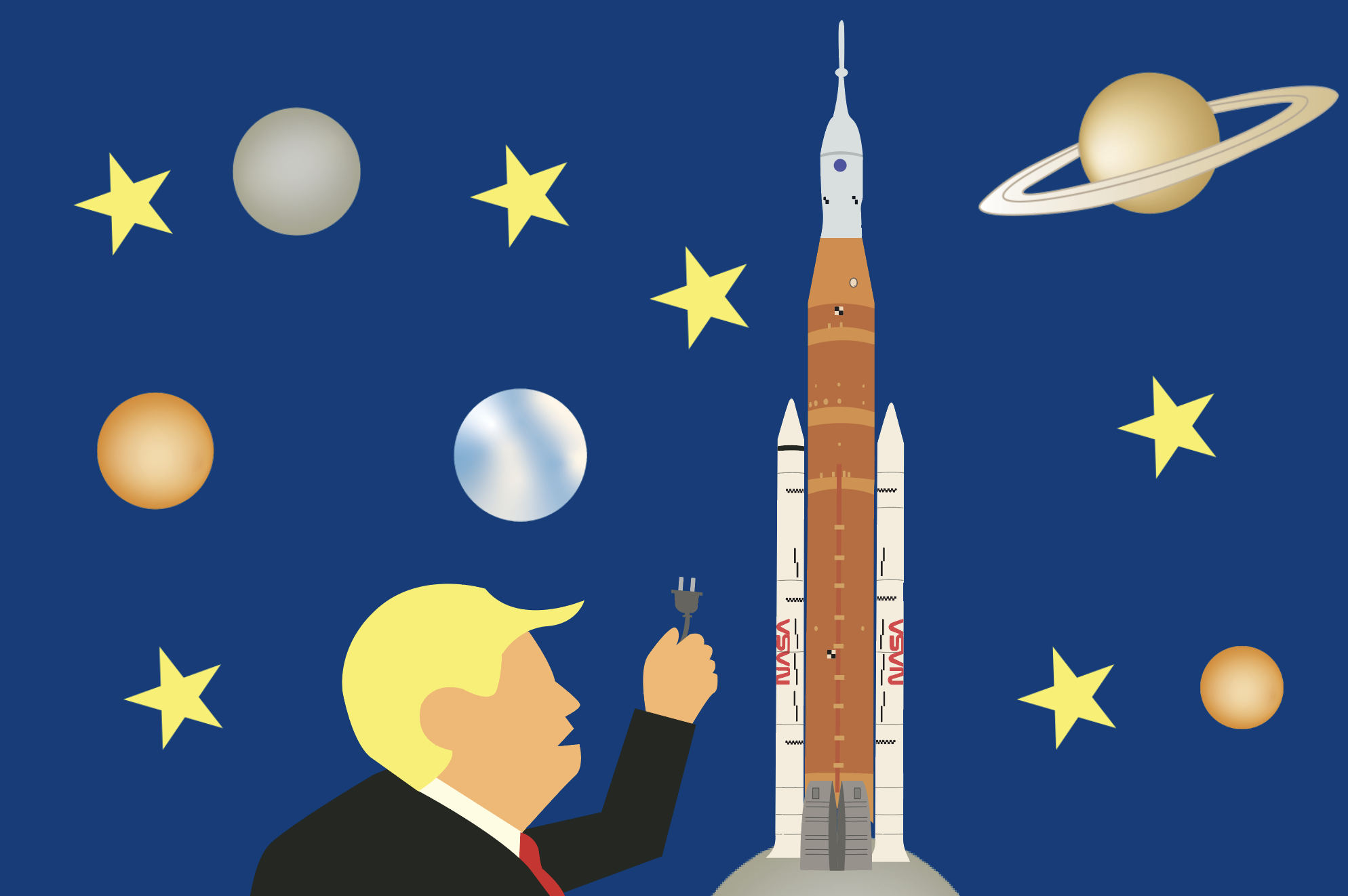
According to Space Policy Online, President Donald Trump has proposed a 23% overall cut to the agency’s funding for the fiscal year 2027, despite the recent NASA success. However, because Trump wants to continue prioritizing Moon and Mars missions, he would make cuts to the climate, earth science and astrophysics programs. Turner said that as soon as these programs are defunded, there will be no foundation for the space programs to build on or receive in-depth research from.
“It’s great to have more recognition for projects like Artemis II, but we’re shifting away from what we can be doing from home,” Turner said.
Similarly, Henry said the government taking initiative does not always help people, and that these funding issues are something to be vocal about as citizens.
“While space discovery is really cool, the effect it has on the average, everyday person is very little,” Henry said. “The effects climate change has on us are going to be very much felt in the coming decades.”
Earth and Space Science teacher Jayce Doolittle said NASA hasn’t had a sufficient budget in a while. Doolittle said NASA is having a lot more talks about future missions now because they plan to deorbit the ISS in 2030. The ISS has high maintenance costs and outdated technology. He said they have done everything with it, but since the ISS is what NASA is known for, they need something else to hold the public’s attention. With the shift from research to missions, Doolittle said the public will be more eager to support material advancement.
“What’s the point of being human if not to explore?” Doolittle said. “Once we explore Earth, we have to find something else to explore. That’s kind of what [humans] do.”
In the next few years, the Artemis III mission with Blue Origin and SpaceX will test equipment, including space suits and docking, and then Artemis IV is planned to be the official lunar landing. Doolittle said that beyond establishing a sustained presence on the Moon, NASA has set its sights on human exploration to Mars.
“[Students] in high school now, who are dreading their next assignment or their AP test, are going to be some of the people working on those missions,” Doolittle said.